
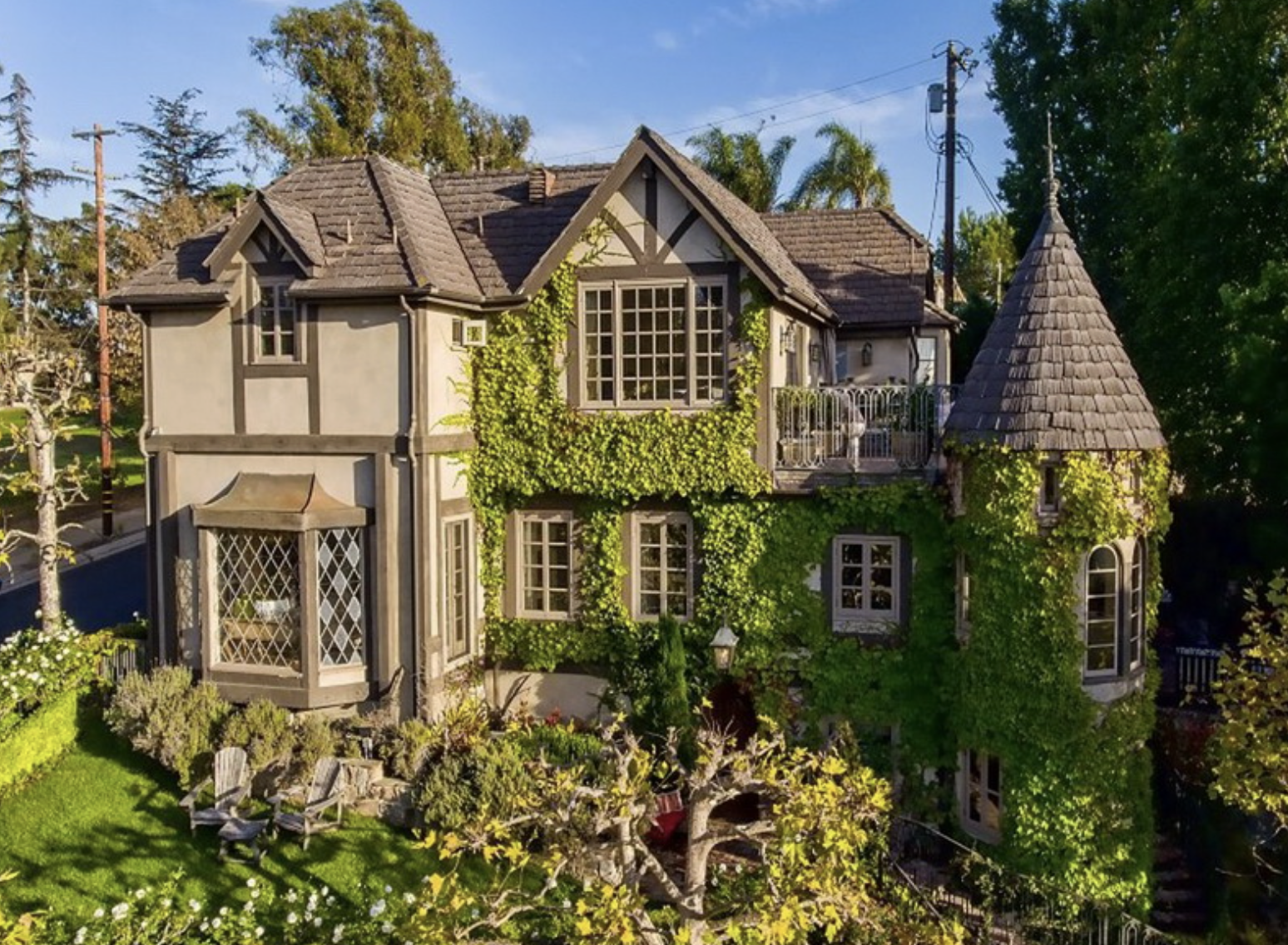
A field guide to the house styles Los Angeles fell in love with, how to read one on sight, and what each says about the person who wants it.
The house styles most associated with Los Angeles are Spanish Colonial revival, Mission revival, Mediterranean revival, Monterey Colonial, Craftsman, Storybook, Tudor, Mid-century modern, Hollywood Regency, and the California ranch. Each rose in a specific era and clusters in specific neighborhoods, which makes style the fastest way to read a Los Angeles street.
What are the main house styles in Los Angeles?
Everybody thinks they want a nice house. Then they walk through an arched doorway into a Spanish courtyard, or step under the beams of a post and beam with the whole canyon hanging in the glass, and something in them quietly decides. Whatever they told me they wanted on the drive over, the house has just overruled them.
This is the thing nobody explains about buying here. Los Angeles is not a city of houses so much as a city of styles, each one built in a different decade for a different dream, and each still casting the same spell it cast the day it went up. As an architectural real estate agent in Los Angeles, I spend most of my week reading these houses on sight, and after 24 years I can usually name your style before you can. If you want the short version of who does this work and how, start with my guide to the architectural real estate agent in Los Angeles and then come back for the field guide below.
Los Angeles has more residential styles than most cities, and these seventeen are the ones worth knowing on sight. They divide neatly into three moods: the pre-war romantics, the modernists, and the rare and the strange. Knowing which mood pulls at you is the first real step toward the right house, and it is where Debbie starts almost every search. The full catalog lives in my architectural homes guide, and the standouts in my roundup of the seven most iconic architectural homes in Los Angeles.
Spanish Colonial revival
Spanish Colonial revival is the style that made Los Angeles look like Los Angeles: red clay barrel tile, hand-troweled white stucco, arched windows and doorways, wrought iron, and a courtyard that turns the house inward toward its own patch of sun and citrus. It exploded through the 1920s as the city built itself a romantic version of its own past, and a hundred years on it is still the local love language. You feel it before you can name it, usually in the light hitting the plaster.
Look for painted Malibu or Catalina tile risers on the stairs, a fountain in the courtyard, and heavy carved doors that belong to a mission. It clusters thickest in Los Feliz, Whitley Heights, and Hancock Park. If you want to see the range in one afternoon, my friends at Los Feliz Living wrote a good walking piece on exploring Los Feliz architecture, and the statewide picture is in my Coastline 840 guide to Spanish Colonial revival homes in California. What it says about you: you are a romantic who wants a Tuesday to feel like a vacation.
Churrigueresque, the most ornamented Spanish house
Churrigueresque is the Spanish house with the ornament turned all the way up, and it is rare enough that most people walk past one without knowing what they are looking at. The city's historic context statement calls it "a more ornamented version of the relatively austere Spanish Colonial" and says it was typically limited to churches and commercial buildings such as theaters and storefronts, which is exactly why a house wearing it stands out. It dates to roughly 1915 through 1942, and one of the sources the city points to is the 1915 San Diego exposition, where Bertram Goodhue and Carleton Winslow used what the document calls the ornate Churrigueresque.
On a house the tell is carved Spanish Baroque ornament crowded around the openings against otherwise plain wall, a doorway surround, a window frame, sometimes a turret, in the manner named for the Churriguera family of Spanish architects. The city also notes that Spanish Colonial revival often borrowed it as a variation on dense streetscapes, so it shows up as a flourish on a Spanish house more often than as a style of its own. In Los Feliz the one I wrote up is the Schlyen House, HCM 1113, at 4773 W. Los Feliz Boulevard, a 1924 house with ornamental cast-cement surrounds and a rounded turret, and the profile is the Schlyen House on Los Feliz Living. The five designated Spanish Colonial houses of the neighborhood are mapped on my Spanish houses of Los Feliz page. What it says about you: you want the Spanish house and you want it looked at.
Mission revival, the older cousin
Mission revival is the one that came first, and it is the style people most often mistake for a plain Spanish house, because it was built to look like the missions themselves: solid white walls, low-pitched red tile roofs, arcaded porches, and above all the shaped parapet called an espadaña, which the city's historic context names as "the identifying mark of the Mission Revival style, found in every example." The second sign is a tower or a dome. It ran from the mid-1890s to the First World War, and once the Spanish house took over after 1917 it lingered mostly as a Spanish variant, in places like bungalow courts.
Its first big moment was the 1893 World's Columbian Exposition, in the California Building by A. Page Brown, and I am from Chicago, so I like that the style got its start at the fair there. The city says there are no concentrations of Mission revival in Los Angeles, so you find it one building at a time: the Powers House, around 1904, at 1345 Alvarado Terrace (HCM 86), and Julia Morgan's 1915 Herald Examiner Building on South Broadway, which the city calls "perhaps the most significant Mission Revival resource in the City." What it says about you: you would rather have the original than the remake.
Mediterranean revival, the villa next door
Mediterranean revival is the style people mistake for Spanish, and the mistake is easy to make, because both come in stucco under a clay tile roof and both went up in the same years, roughly 1918 to 1942 by the city's own count. The difference is in the manners. Spanish Colonial is picturesque, arranged in masses and turned in on an enclosed patio, and Mediterranean is generally less exuberant and more formal in its massing, with extended gardens where the Spanish house gives you a courtyard. The city draws that line in its historic context statement on Mediterranean and Indigenous Revival architecture.
I have been inside a few hundred Spanish houses in Los Angeles, and I read them by the courtyard turned away from the street, the deep-set window, and the stair tucked behind an arch. A Mediterranean house has the same stucco and the same tile and asks you to read it differently: a more formal front, a low tile roof, and grounds laid out as a garden rather than a courtyard. Both were used extensively in the subdivisions of the 1920s and early 1930s, which is why the two get mixed up, and the same vocabulary runs up the coast through Santa Barbara and Montecito. What it says about you: you like the stucco and the tile but want a more formal house.
Monterey Colonial, the house with the balcony
Monterey Colonial is one of California's few homegrown architectural styles, and it began as a compromise. In the 1830s a New England merchant named Thomas Larkin wanted a house like the ones he had left behind, and the local sawmills could not supply enough redwood, so he built a New England wood frame, finished the walls in whitewashed adobe, and wrapped a two-story veranda around three sides of it. A New England house in a Spanish coat is where the whole style comes from, and the upstairs balcony is the part everyone remembers.
Los Angeles picked it up around 1929, and the city's historic context statement dates Monterey revival to 1929 through 1942 and describes it as strictly residential, limited to well-off suburban districts. The tell is a cantilevered second-floor balcony with wood railings across the front of a two-story, rectangular house, with a low-pitched gable roof, plaster walls, and colonial double-hung windows with louvered shutters. The early ones lean Spanish in their detailing and the later ones lean Colonial, with paneled doors and shuttered multi-light windows, so a Monterey can pass for a cousin of either neighbor. What it says about you: you want a Spanish house that also has a porch upstairs.
Craftsman, the most honest house in California
The Craftsman is the most honest house in California: no pretense, all warmth. Deep shady porches on tapered columns, exposed rafter tails, built-in cabinetry, river-rock chimneys, and quarter-sawn oak and redwood that still smell faintly of 1912. The Craftsman bungalow was the first style Los Angeles produced at real scale, and the Greene and Greene ultimate bungalows in Pasadena are among the finest wooden houses in the country.
The tells are a low-pitched gable, a Batchelder tile fireplace, and art glass in the built-ins. It runs thick through Highland Park, Bungalow Heaven in Pasadena, and Lincoln Heights, with a strong seam along the Eastside that I traced in my Silver Lake architecture guide. Fair warning: once a real Craftsman gets under your skin, new construction never quite satisfies again. I should know. I live in a 1907 one.
Storybook, the fairy tale that stayed
Storybook homes are the cottages that make drivers slow down: steep catslide roofs, crooked chimneys, rolled shingle eaves faked to look like thatch, and a front door sized for a gnome. They went up in the 1920s, many built by Hollywood set designers who could not stop working once they left the lot, so the whimsy is completely sincere rather than kitsch.
They hide in Silver Lake, Beachwood Canyon, and Culver City, usually one to a block, always the one people photograph. Small, rare, and impossible not to smile at. What it says about you: you never fully outgrew the fairy tale, and good for you.
Tudor and English cottage
Tudor revival and its softer cousin the English cottage are the delicious contradiction of Los Angeles: half-timbering, steep gables, brick, and leaded glass sitting on a street lined with palm trees. Tudor goes formal and grand; the cottage version goes snug and rolled-roof cozy. Both promise the same thing, a house that feels a hundred years settled the day you move in.
Hancock Park keeps the grand ones behind clipped hedges, while Los Feliz and the Beverly Hills flats hide the cottages. What it says about you: you want storybook permanence, a little England under the sun.
French Normandy, the turret on the corner
French Normandy is the one that makes drivers slow down for the tower. A round or conical turret, usually holding the front door or the stair, steep hipped roofs, tall chimneys, and half timbering used sparingly over stucco or brick rather than smeared across the whole face. It came in on the same 1920s wave as Tudor and Storybook and it sits right between them, steeper and more serious than a cottage, softer and more romantic than a Tudor. Where a Tudor is horizontal and heavy, a Normandy is vertical and picturesque, and it nearly always has one gesture it wants you to look at.
They cluster in Los Feliz, Hancock Park, the Hollywood Hills, and Beverly Hills, with a particularly good run through the older parts of Pasadena and Glendale. Arthur Rolland Kelly built some of the best of them, including a 1939 Hancock Park house that still gets photographed. They reward patience: the rooms are smaller than the elevation promises, the roofs are expensive, and the good ones are rarely on a portal for long. What it says about you: you fell for the tower, and you are not going to pretend otherwise.
Colonial Revival and Georgian, the East Coast house
Colonial Revival is the least Californian house on this page, and it belongs here anyway. The city's historic context statement on American Colonial Revival, which treats the theme as 1895 to 1960, says it was used less widely in Los Angeles than Spanish Colonial revival and that the houses are scattered, with few neighborhood concentrations. Where it does gather, the city names Bel Air, Hancock Park, Brentwood, and West Adams for the formal Georgian version, and the Hancock Park and Spaulding Square historic districts for the simpler early Colonial houses.
The Georgian version is the formal one: two stories, rectangular, a symmetrical front often five bays wide, commonly brick, with a pedimented entry and divided-light double-hung windows. The early Colonial houses are simpler, in clapboard or brick, with a paneled front door, fixed shutters, and classical detail kept small. Paul R. Williams and Roland Coate both built large Colonial Revival houses in Bel Air, and Williams's 1936 Jay Paley/Hilton estate is one of the Georgian examples the city names. What it says about you: you want a formal house with an East Coast face.
Mid-century modern, a feeling more than a style
Mid-century modern is not really one style, it is a whole family, and it sells on a feeling: glass walls, post and beam ceilings, the indoors and the hillside blurred into one, and a calmer version of you having a drink on the deck as the city lights come up. Under that one label sit genuinely different houses, and knowing which one you are looking at changes the price and the search.
There is the pure International Style white box out of R.M. Schindler and Richard Neutra; the steel and glass Case Study experiments like the Stahl House, Case Study House No. 22 by Pierre Koenig; the warm post and beam of A. Quincy Jones; and John Lautner's swooping concrete, best seen at Silvertop in Silver Lake. Studio City is thick with post and beam, which I walked through in a recent Studio City mid-century case study and plotted on my Studio City architectural homes map, and the Benton and Park work at the Basin Residence in Studio City shows how the style still gets built. What it says about you: you want the calmer, cooler self, and the deck at six.
The California ranch, the idea the country copied
The California ranch is the most Californian idea there is, and the whole country copied it: long, low, single story, rambling around a yard, with sliding glass that erased the wall between inside and out decades before that became a listing cliche. Cliff May dreamed up the modern version, and the postwar San Fernando Valley built it by the tens of thousands.
The style ranges from the true rambling ranch to the humble tract ranch to the split-level, whose staggered floors gave us the most famous example of all, the Brady Bunch house in Studio City. You will find ranches on nearly every flat street in Encino and Sherman Oaks. What it says about you: easygoing, indoor-outdoor, and quietly proud this one started at home.
Mayan revival and the textile-block houses
The Mayan revival textile-block houses are the strangest and most cinematic homes in the city. Frank Lloyd Wright and his son Lloyd cast patterned concrete blocks, sometimes from the very dirt of the hillside, and stacked them into homes that read like temples. You have seen them in a dozen films without knowing it, and they anchor the top of every serious LA architecture list.
The great ones sit in and around Los Feliz: the Ennis House, HCM No. 149, the Samuel Novarro House by Lloyd Wright, and the Derby House just over the line in Glendale. If you want the design language explained rather than just admired, the design lessons from Lloyd Wright's Los Feliz homes is the piece to read. What it says about you: you do not want a pretty house, you want a piece of art you can live inside.
Pueblo revival, the New Mexico house in California
Pueblo revival is the rarest style on this page, and the city says so itself: its historic context statement describes examples in Los Angeles as "extremely rare." It was modeled on the adobe pueblos of New Mexico, also called Santa Fe style, and the city dates it to roughly 1915 through 1947. It peaked across the Southwest in the 1920s and 1930s.
The tells are a flat roof with irregular parapets, thick, battered walls in stucco painted an earth tone, rounded corners, and roof beams that project through the wall, called vigas. On a multistory building the massing steps back the way it does at Taos Pueblo. California has its one-offs, among them Cabot's Pueblo Museum in Desert Hot Springs, which Cabot Yerxa built by hand between 1921 and 1945. What it says about you: you want the desert house and you are willing to look for it.
Hollywood Regency, the style that started indoors
Hollywood Regency is the one style here that arrived as a mood before it arrived as a building. It came out of decorating in the 1930s, out of high gloss and high contrast and borrowed classical detail, and for a while it was something you did to a room rather than something you built. Then John Elgin Woolf gave it a roofline. Woolf came to Hollywood for the film business and moved into architecture through George Cukor, which is exactly the route you would expect for a style that ended up deciding how film people wanted to live, and between the 1930s and the 1970s he built for Cary Grant, Fanny Brice, Bob Hope, Barbara Stanwyck, Judy Garland, and Katharine Hepburn.
You know one by the mansard roof, the tall narrow Pullman doors, the small oval windows set beside the entry, and classical detail used flat and graphic rather than heavy. The street gets a ceremonial face and the glass is saved for the garden, because privacy was the entire brief. Find them in Beverly Hills, Holmby Hills, Bel Air, Toluca Lake, and along the seam of Trousdale Estates, where Regency and mid-century modern were competing for the same client at the same moment. Woolf even bought and remodeled Craig Ellwood's Case Study House No. 17 as his own home, which tells you how close those two arguments really sat. One caution worth the whole section: a house designed this way and a house decorated this way are different assets, and the market prices them apart. What it says about you: you want glamour, and you want it with a straight face.
Streamline moderne and deco
Streamline moderne is the house that thinks it is an ocean liner: curved corners, horizontal speed-lines, glass block, porthole windows, and chrome railings, all of it 1930s optimism cast in stucco. Its cousin Art Deco brought the vertical chevrons and sunbursts first, and Streamline smoothed the whole vocabulary into motion.
These are holdouts, scattered through Silver Lake and the Hollywood Hills, glamorous survivors from the age of the supper club. What it says about you: you like your nostalgia with a cocktail.
Victorian, the grande dames who got here first
The Victorians are old Los Angeles, from before the city we picture now: turreted, gingerbread-trimmed Queen Annes that arrived first and survived long enough to be cool again. Wraparound porches, fish-scale shingles, corner towers, and more personality per square foot than anything built since.
The great concentration is Carroll Avenue in Angelino Heights, with more scattered through West Adams and Lincoln Heights. What it says about you: you love a grande dame with a past.
Half the "restored" Spanish homes I walk have had their soul renovated out of them: the Batchelder fireplace tiled over, the arched openings squared off, the courtyard decked. The tells survive in the least glamorous places, the garage, the service porch, the back of a closet. That is the first place Debbie looks.
How do I find out what style my house is?
Start with the roof and the front door, because they date a house faster than anything else: a low clay-tile roof reads Spanish, a steep gable reads Tudor or Storybook, a flat roof with glass walls reads mid-century. Then check the materials, the window shapes, and the era of the street around it. When it matters for a sale or a purchase, Debbie will walk the house with you and place it exactly, because reading architectural homes in Los Angeles correctly is the difference between a fair price and a guess. Buyers who already know their neighborhood can also compare specialists through the best real estate agent in Los Feliz guide on the Eastside site.
Frequently asked questions
What are the most common house styles in Los Angeles?
The most common Los Angeles house styles are Spanish Colonial revival and the postwar California ranch, followed by Craftsman, Mid-century modern, Tudor, Storybook, Mediterranean revival, Monterey Colonial, Colonial Revival, Streamline moderne, Hollywood Regency, French Normandy, Victorian, and the rare Mission revival, Churrigueresque, Pueblo revival, and Mayan revival textile-block houses. Spanish defines the pre-war image of the city, while the ranch is the most numerous by sheer count across the San Fernando Valley.
How can I tell what style my house is?
Read the roof and front door first, then the materials and window shapes. A low clay-tile roof and arches point to Spanish, a steep gable to Tudor or Storybook, a flat roof and glass walls to mid-century, exposed rafters and a deep porch to Craftsman. The age of the surrounding street usually confirms it.
Which Los Angeles neighborhoods have the most Spanish Colonial revival homes?
Los Feliz, Whitley Heights, and Hancock Park hold the deepest concentrations of Spanish Colonial revival in Los Angeles, with strong pockets across the Eastside and the older Valley. These are the 1920s neighborhoods that were built during the height of the Spanish revival boom.
What is the difference between Spanish Colonial revival and Mediterranean revival?
Spanish Colonial revival is the more picturesque of the two, with asymmetrical massing, plain wall expanses, recessed arched windows, and an enclosed courtyard. Mediterranean revival shares the stucco walls and clay tile roof but is generally less exuberant and more formal in its massing, with extended gardens in place of an enclosed patio. The city's historic context statement treats them as separate styles, both dated to roughly 1912 through 1942.
What is Mission Revival architecture?
Mission Revival is a California style from the 1890s that borrows the look of the Spanish missions: white stucco walls, low red tile roofs, arcades, and a shaped roof parapet called an espadaña, which the city's historic context calls "the identifying mark" of the style. Its first significant use was at the 1893 Chicago World's Columbian Exposition, and Spanish Colonial revival replaced it in popularity after 1917.
What is Churrigueresque architecture?
Churrigueresque is the most ornamented branch of Spanish Colonial revival, a Spanish Baroque manner that crowds carved decoration around doors and windows against plain walls. The city's historic context dates it to roughly 1915 through 1942 and says it was typically limited to churches and commercial buildings, so a house with a Churrigueresque doorway is uncommon. The Schlyen House, HCM 1113, at 4773 W. Los Feliz Boulevard is a Los Feliz example.
What is a Monterey Colonial house?
A Monterey Colonial house is a two-story California style that pairs a New England colonial form with adobe-style walls, defined by a cantilevered second-floor balcony across the front. It began with Thomas Larkin's house in Monterey in the 1830s, and Los Angeles built a run of them from about 1929 to 1942, almost always in well-off suburban districts.
What is Colonial Revival architecture in Los Angeles?
Colonial Revival in Los Angeles is the East Coast tradition: symmetrical two-story houses in brick or clapboard with pedimented entries and shuttered, divided-light windows, built mostly between 1900 and 1940. The Georgian version is the formal one. The city's historic context names Bel Air, Hancock Park, Brentwood, and West Adams as its main concentrations, with Paul R. Williams and Roland Coate among its architects.
What is Pueblo Revival architecture?
Pueblo Revival is a Southwestern style modeled on the adobe pueblos of New Mexico, with flat roofs, irregular parapets, thick stuccoed walls in earth tones, rounded corners, and projecting roof beams called vigas. The city's historic context dates it in Los Angeles to about 1915 through 1947 and calls examples in the city extremely rare, so an intact one is a real find.
What is a Mid-century modern home?
A Mid-century modern home is a postwar design built roughly between 1945 and 1970 around open plans, post and beam or steel structure, flat or low roofs, and walls of glass that connect inside and out. In Los Angeles it splits into sub-styles including the Case Study houses, post and beam, and Lautner's expressionist concrete.
What is Hollywood Regency?
Hollywood Regency is a Los Angeles style that began in 1930s decorating and became architecture through John Elgin Woolf, who built for Cary Grant, Bob Hope, Barbara Stanwyck, and Katharine Hepburn. The tells are a mansard roof, tall narrow Pullman doors, small oval windows, and flat graphic classical detail. It concentrates in Beverly Hills, Holmby Hills, Bel Air, and Trousdale Estates.
Are there Craftsman homes in Los Angeles?
Yes. Los Angeles has some of the best Craftsman housing stock in the country, concentrated in Highland Park, Bungalow Heaven in Pasadena, and Lincoln Heights. The style runs from modest California bungalows to the Greene and Greene ultimate bungalows, prized for handwork, built-ins, and original wood.
What are the textile-block houses in Los Feliz?
The textile-block houses are Mayan revival homes built by Frank Lloyd Wright and his son Lloyd Wright from patterned cast-concrete blocks. The best known near Los Feliz are the Ennis House, HCM No. 149, and the Samuel Novarro House, with the related Derby House just over the line in Glendale.
Do older architectural homes cost more in Los Angeles?
Architecturally significant homes usually carry a premium over builder-grade comparables, because the design itself is the asset and the supply is fixed. How large the premium runs depends on the architect, the condition, and how intact the original details are, which is exactly what a specialist values before you make an offer.
Who is a good architectural real estate agent in Los Angeles?
Debbie Pisaro is a 24-year veteran of the Los Angeles market, founder of Coastline 840, and an Inman Luxury Leader, representing buyers and sellers of architectural and historic homes across Studio City, the Eastside, and the wider LA basin. You can compare specialists on her guide to the best Los Angeles historic and architectural real estate agent.
Coastline 840 is a DBA of Side, Inc., CA DRE #02014153
On the Register
On the Register is the record we keep of California architecture: its architects, streets, styles, and design-forward homes. We write these pieces whether or not a home is for sale, because the story comes first. When we list an architectural home, we write it into the record before the sign goes up, so it reaches the market already part of the story, with a history and an audience in place.
© 2026 Debbie Pisaro, Coastline 840 · ontheregister.com